Archive for 'News'
Community Meeting with Contractor/Caltrans
Posted on 21. Feb, 2010 by admin3.
SAVE THE DATE – THURSDAY, MARCH 25, 7:00 PM
Caltrans will hold a community-wide information meeting regarding the Caldecott Tunnel Fourth Bore construction on Thursday, March 25, at Kaiser Elementary School - 25 South Hill Court (off Hiller Drive) – Oakland.
The agenda is in the works. In the meantime, please consider this meeting as your opportunity to get the most current details about the project, its construction phasing and schedule, traffic and noise management plans, air quality management, community communications, discuss concerns, and get questions answered.
The Fourth Bore Coalition has asked that the contractors’ project managers attend as well as Caltrans’ construction managers and project information officer.
Caltrans has posted a skeletal (and very slow) website for the project at http://www.caldecott-tunnel.org/. You can subscribe to their direct email list and post questions “CIP Comments/Contact”. Also, the FBC website links to specific pages on the project website in the right sidebar section labeled “CIP Information”.
Continue Reading
TREE REMOVAL TO START NEXT WEEK
Posted on 19. Feb, 2010 by admin3.
Caltrans will begin tree removal on the project next Tuesday (2/23),
starting on the east side. They’ll most likely move to the west side on
Thursday (2/25). It will take about 8 working days. Tree clearance will make
way for the staging areas, mini-electrical substation, temporary soundwall,
etc.
The trees will be felled with chain saws in order to comply with storm water
restrictions. (No large excavators to stir up the soil and create sediment
in the rainwater runoff.) The trees will be cut into smaller pieces and
removed with minimal disturbance of the soil. The work must be completed by
March 1, to comply with environmental regulations covering migratory birds.
(After March 1, certain birds will have returned to the area to nest.)
These areas will be re-landscaped after construction is completed. Any native trees that will be removed will be replaced, at a ratio greater than 1:1. For example, oak trees will be replaced at a 5:1 ratio , based on the ratio in the Oakland settlement agreement
Continue Reading
Route 24/Hwy. 13 Interchange Project Starts
Posted on 04. Feb, 2010 by admin3.
from www.caldecott-tunnel.org
The freeway connector between westbound Route 24 and northbound Highway 13 will need to be modified to accommodate traffic arriving from the third and fourth bores of the Caldecott Tunnel. Construction is expected to start in April 2010 and completed in Spring 2011.
The interchange with Highway 13 is fairly close to the west portal of the Caldecott tunnel. By realigning the ramp, Caltrans will provide more space for the traffic coming from the two westbound bores.

Continue Reading
Kay Street Construction Project Begins
Posted on 04. Feb, 2010 by admin3.
from www.caldecott-tunnel.org website
Few motorists know it by name, but Kay Street is the overcrossing just west of the Oakland
portal of the Caldecott Tunnel that connects Caldecott Lane on the north to Broadway on the south. The road is most often used by motorists during the afternoon commute who are driving southeast on Telegraph Street in Berkeley and heading for the Caldecott Tunnel.
Project Benefits
This project will install a traffic signal at the congestion-prone intersection of Kay Street and Broadway to improve traffic flow. Congestion is currently caused by two streams of traffic vying for the last on-ramp on eastbound Route 24 before the Caldecott Tunnel.
Also, motorists on Broadway wishing to make a left turn on Kay Street towards Berkeley face long delays during the afternoon, as traffic turning from southbound Kay Street has the right of way.
Ghilotti Brothers, Inc. posted the apparent low bid of about $311,000 on November 18, 2009. The contact was awarded on December 23, 2009. Construction should begin by mid-March 2010 and must be finished by June 25, 2010.
A separate portion of the project will modify the intersection of Kay Street and Caldecott Lane, widening the intersection to improve traffic flow.
This project also will enhance bicycle and pedestian flow at the Kay Street/Broadway intersection.
Continue Reading
Schools get $3 million for air pollution, noise mitigation from State Legislature
Posted on 05. Jun, 2009 by admin3.
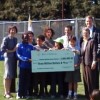
reprinted with permission from the Rockridge NewsWith money to support a settlement reached in January between Caltrans and the Fourth Bore Coalition, state Sen. Loni Hancock, D-Berkeley, and Assemblywoman Nancy Skinner, D-Berkeley, presented a check for $3 million to Oakland Unified School District officials on April 17 on the baseball field at Chabot Elementary School .
Specialized air-filtration systems and trees will be installed at Chabot Elementary School and Claremont Middle School. These measures will help mitigate air quality and noise impacts from increased traffic caused by the fourth Caldecott Tunnel bore, scheduled to begin construction this summer.
Of the funds, $2 million comes from the state Air Resources Board for upgrades to the ventilation systems of all buildings and classrooms at both schools. An additional $1 million grant was provided by CalFire’s Urban Forestry Program for landscape barriers to mitigate noise expected from increased traffic expected to occur after construction of the new tunnel bore.
Continue Reading
CALDECOTT LAWSUIT SETTLES UNDER THREAT FROM GOVERNOR
Posted on 17. Mar, 2009 by admin3.
reprinted from the February 9, 2009 Rockridge News
Governor Schwarzenegger’s demand that the Caldecott Improvement Project – also known as the Caldecott Tunnel Fourth Bore Project – move forward, plus the intervention of the legislature’s Democratic leadership, pressured the Caldecott Tunnel Fourth Bore Coalition (FBC), which includes RCPC among its members, into accepting a settlement of its lawsuit over adding the fourth bore to the tunnel.
Although less than what the FBC hoped for from its suit, the settlement terms are an improvement over what Caltrans had offered during extended discussions last year.
As reported in January’s Rockridge News, the Governor, in the name of providing an “economic stimulus,” proposed a retroactive exemption from the California Environmental Quality Act (CEQA) for the Caldecott project and 10 other highway projects. He stated flatly that he would not sign an amended budget unless it included those exemptions, effectively holding the State budget hostage.
The Democratic legislative leadership, and particularly Senate President Pro Tem Darrell Steinberg, strongly opposed this move. Nevertheless, the FBC was told candidly that, given solid Republican support and other legislators’ fear of being blamed for the State’s insolvency, the CEQA exemption was likely to pass. The result would have been to derail and negate the pending lawsuit (the judge had been expected to issue a decision within weeks) and leave the FBC with nothing to show for its years of efforts.
At the suggestion of Senator Steinberg and California League of Conservation Voters President Tom Adams, FBC leaders and legal counsel met with Caltrans to hammer out a settlement.
The most significant result of the settlement was Caltrans’ commitment to spend $2 million for improvements to State Route (SR) 13, the Ashby Avenue and Tunnel Road corridor, including improvements for some intersections and for pedestrian and bicycle travel. These will help offset traffic increases expected with the new fourth bore.
Caltrans also committed to spend up to $250,000 for a study of the entire SR 24 corridor, from I-580 to I-680. It will consider potential transportation improvements, including High Occupancy Vehicle lanes (HOV) and/or toll lanes, BART and other transit service improvements, current and projected noise levels at the Rockridge BART station platform, and reducing other major impacts of the highway including traffic, noise, and air pollution. However, it provides no funds to implement the study’s results.
Fourth Bore Coalition negotiators were unable to prod Caltrans to do much more to alleviate major construction impacts on those living close to the project. Oakland, in its settlement earlier of a threatened suit, got Caltrans to restrict hauling operations to daylight hours and to limit nighttime noise increases; Caltrans adamantly refused to go any further. However, the highway construction agency did commit, reluctantly, to using low-sulfur diesel for off-road construction equipment. This will help reduce the project’s effect on local air quality. Caltrans also committed to keeping dirt-hauling trucks off local streets and to work with the community to minimize impacts from dirt stockpiling at or near the site.
Caltrans also agreed to fund a barrier along the highway’s edge above FROG Park to protect the park from falling debris, and agreed to consider expanding the park by including unused Caltrans right-of-way land. These agreements will not mitigate the expected noise impacts on the park, but provide some protection and compensation. The agency also committed an additional $100,000 for FROG Park or bicycle transit improvements or to provide additional support for the SR 24 corridor study.
Last, but certainly not least, were several commitments made, not by Caltrans, but by Senator Steinberg and the Democratic Legislative leadership, that promised up to $2 million for noise and air quality mitigation efforts at Chabot Elementary and Claremont Middle schools, as long as the school district provided adequate documentation justifying the expenditures.
Steinberg’s office also promised to work with the East Bay Bicycle Coalition (EBBC) and BART to identify State funds for bicycle transit improvements along the corridor. An unnamed legislator also apparently agreed to carry a bill that could lead to Department of Motor Vehicles (DMV) land along Claremont Avenue being converted to public recreational use once the current building reaches the end of its useful life.
Neither the settlement itself nor the process was what the FBC had hoped for. Still, all in all, especially given the unpleasant circumstances, the settlement provides a small but significant offset to the many impacts the Caldecott project will have on the Oakland/Berkeley community. Perhaps the most unfortunate part of the outcome is what it says about our dysfunctional California political system, and how it was so willing to sacrifice the environment and our community to satisfy special interests.
Continue Reading
Governor Proposes CEQA Exemption for Fourth Bore
Posted on 05. Mar, 2009 by admin.
CALL YOUR LEGISLATIVE OFFICIALS ! Tell them exempting the proposed Caldecott Tunnel’s Fourth Bore project from environmental review, when there are unmitigated impacts, is unacceptable.
Continue Reading
Caldecott Project Lawsuit Now in Judge’s Hands for January Decision
Posted on 05. Mar, 2009 by admin.
Reprinted from the Rockridge News
After two three-and-a-half hour sessions of oral argument, the Fourth Bore Coalition’s lawsuit challenging Caltrans’ Caldecott Improvement Project has been submitted to Alameda County Superior Court Judge Frank Roesch for a decision. With almost 90 pages of briefing and more than 32,000 pages of administrative documents to read through, that decision could be a while in coming.
The Fourth Bore Coalition (FBC) includes the Rockridge Community Planning Council (RCPC) as well as the FROG Park Committee, East Bay Bicycle Coalition, and several other Oakland/Berkeley community groups. FBC sued Caltrans over its decision, made over a year ago, to add a fourth bore, or tunnel, to the Caldecott
Tunnel connecting Alameda and Contra Costa counties.
The suit is not about whether a fourth bore should be built. Rather, the Coalition asked reconsideration of how it would be built, how it should be operated, and what mitigation measures should have been included with the project. In the two hearings, the Coalition was represented by local attorneys Stuart Flashman and Antonio Rossmann. The hearings covered a wide range of issues from noise, lighting, traffic, bicycling and pedestrian safety impacts to whether Caltrans should have looked at having carpool/bus lanes as part of the project.
Judge Roesch listened attentively throughout and asked probing questions of both sides. The Judge seemed particularly skeptical of why Caltrans chose to limit the area it looked at for project impacts and to exclude consideration of impacts on Claremont Middle School and Chabot Elementary School - both located very close to Highway 24 and the traffic coming and going through the tunnel.
Under state law, the judge must issue his decision within 90 days. The case was submitted for decision on November 5.